Workout Photo Check-Ins vs Fitness Dashboards for Habit Building
Photo check-ins beat dashboards for building new workout habits.
· Updated
Most people who download a fitness app quit before any real habit takes hold, and it happens fast. This piece is about why that happens, and about picking the right tool for the moment you're actually in, rather than the one with the most impressive-looking screen.
ACE Fitness research found habit formation can start within roughly two months, though the full range stretches from a matter of days to nearly a year. That's a wide window, but the pattern inside it is consistent: the first weeks decide everything. Beginners are the shakiest group by far. Someone who's been training for years has already built habits that don't depend on any single app, reminder, or streak counter. A beginner has none of that scaffolding yet, so whatever tool they pick during those first weeks is doing a lot of load-bearing work.
Dashboards run into trouble, and it has nothing to do with being badly built. Fitness progress is slow by nature. A dashboard tracking your squat depth or resting heart rate won't show anything meaningful for weeks, sometimes months. Compare that to a food delivery app, which proves its value the second your burrito shows up. A fitness dashboard asks for patience up front, before trust has been earned.
A screen full of flat lines in week two doesn't read as "stay the course." It reads as "this isn't working," which is the opposite of what a new exerciser needs to hear from their own phone. That's a mismatch between the tool and the moment, not a flaw in the person using it. The dashboard was built for someone who already has a habit to measure. The person who just downloaded the app is still trying to build one.
The Habit Science of Showing Up
Two mechanisms explain most of what makes a new habit stick in those early weeks: self-monitoring and social accountability. Self-monitoring is simple. Tracking a behavior, even loosely, makes you more likely to repeat it. Social accountability adds a second layer on top: knowing that another person will see whether you showed up changes your behavior before you even start.
These two reinforce each other. A 2025 meta-analysis covering 42 studies found that people with structured accountability systems in place were substantially more likely to stick with new habits than people going it alone. The brain gives you a reason to understand why. Early workouts come with a dopamine spike, novelty is exciting, but that chemical boost fades with repetition. By weeks three through eight, the thrill is gone and the habit hasn't yet become automatic. That's the exact stretch where most people quit, and it's the stretch where something external, like another person checking in, has to do the job the brain stopped doing on its own.
A 2025 cross-sectional study of social media users backs this up from another angle: fitness-related social media use predicted intrinsic motivation, exercise intention, and actual exercise behavior, with motivation and intention acting as the bridge between social visibility and what people actually did. Being seen changes behavior, not just mood.
What falls out of all this is a design rule, not a research footnote: the two things that move the needle early on are social visibility and a binary yes-or-no confirmation, not a rich pile of metrics. Trainers who work with people new to tracking tend to recommend exactly this: done or not done, nothing more complicated. That's the design brief photo check-ins were built to answer, before any feature comparison even starts.
Photo Check-Ins as a Two-Tap Action
A workout photo check-in is about as close as you can get to pure self-monitoring. Taking the photo and sending it isn't a report about the workout, it is the confirmation of the workout. There's no translation step, no filling out a form afterward trying to remember what you did.
It checks the binary box the research points to: done or not done, decided in one gesture. When a workout gets shared this way, the reward is knowing someone noticed, not just finishing the set. That second reward, the social one, is something a private log sitting alone on your phone simply can't produce.
SweatCam, the photo check-in mechanic built into Sweatmates, runs on exactly this logic. Users set a weekly goal, then submit photo proof through SweatCam each time they work out. The photo itself is the proof of presence. It isn't measuring how much weight moved or how fast the mile was. Sweatmates treats showing up as the signal worth capturing, a different and deliberate bet than the one dashboards make.
The weekly pact structure matters here too. Because the commitment resets every week rather than running as a single long-term challenge, the social loop stays active even after the first-month excitement wears off, which lines up with the weeks three-through-eight gap the dopamine research describes. Research on social visibility shows that knowing someone else will see whether you showed up creates a compound motivational effect, a mechanism that fitness accountability tools like Sweatmates activate by design, pairing the simple act of checking in with the extra lift of reporting success to someone who's actually paying attention.
Sweatmates also lets partners add a light accountability amount, a small wager, on top of the photo check-in itself. That adds a second layer of pressure beyond pure visibility, and the question of whether visibility alone is enough to carry someone past month two comes up again later in this piece.
What fitness dashboards do well, and for whom
Dashboards are built to measure and display what a person has already built, and their usefulness grows in direct proportion to how consistent that person already is. A beginner staring at a dashboard gets noise. Someone six months into a lifting program gets a story they can actually read.
For experienced exercisers, adherence tends to be much higher, and the habit itself runs with less outside help. For experienced exercisers, data on progressive overload, recovery windows, and performance trends becomes genuinely useful. Trainers tend to draw this line clearly: beginners do better with stripped-down dashboards showing fewer numbers, while advanced users want the opposite, detailed analytics, custom workout builders, raw exports they can dig through on their own.
A dashboard's real strength becomes visible over time. Twelve weeks of data can reveal a trend, a plateau, a recovery pattern after an injury, things that are invisible without a history to compare against. None of that exists yet for someone in week two.
That's exactly when things go wrong, when a dashboard gets handed to someone who hasn't built the consistency that makes the data worth looking at. Overloaded dashboards, messy syncing between devices, and a constant stream of notifications are well-documented causes of early dropout, and they're not bugs so much as symptoms of a tool pointed at the wrong stage of the process. A dashboard showing flat or barely-moving numbers in week two doesn't push someone forward.
Where each tool belongs on the habit timeline
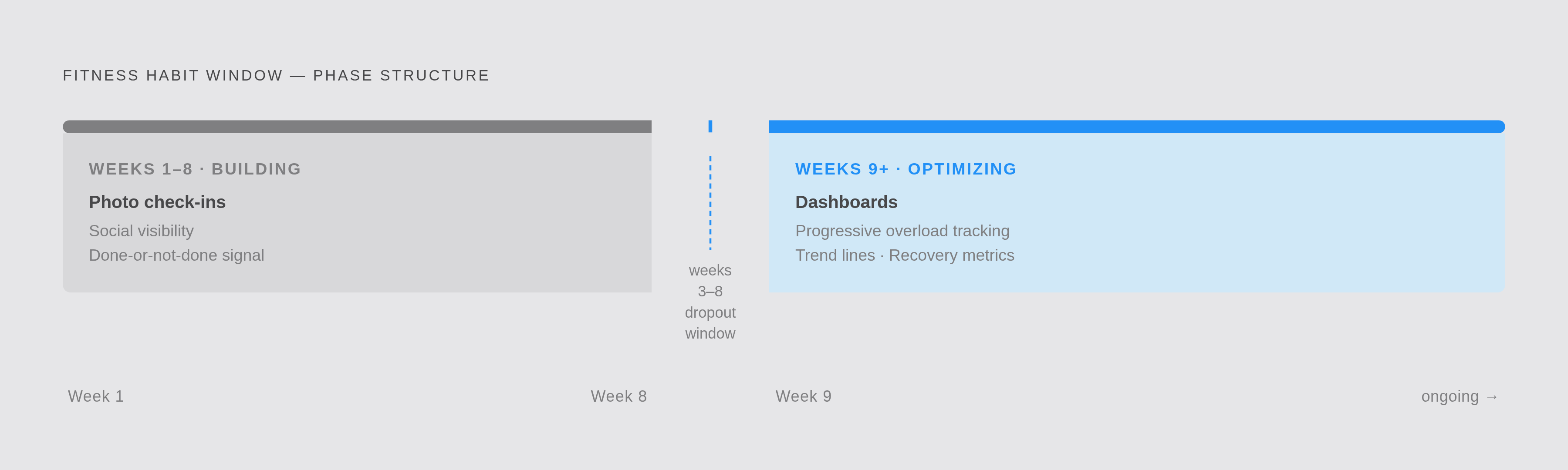
The right tool is a matter of timing, not taste. The early weeks call for social visibility and a simple done-or-not-done signal. The later stage calls for depth and detail.
Picture someone in week two of a new routine. They don't need to know their heart rate variability trend. They need a reason to show up tomorrow, and a partner noticing their photo today does more for that than any chart could. Now picture someone six months into consistent training, chasing a strength goal. A twelve-week trend line on their squat numbers tells them something real, something a photo alone never could.
That's the shape of the first eight weeks or so: the window where most habits either take hold or die, and the stretch where photo check-ins do the heavy lifting that dashboards simply aren't built for yet. The social reward of a partner's reply stands in for the dopamine hit that's already starting to fade by that point. Once consistent behavior is already in place, the dashboard earns its complexity. Progressive overload numbers, trend lines, recovery metrics, all of it becomes meaningful because there's finally a baseline to measure against. Even experienced athletes lean on social accountability during rough patches, but for them it's a tool for the occasional slump, not a foundation they depend on daily.
The common misstep is reaching for the fancier-looking tool first. A twelve-metric dashboard looks serious and feels like commitment, but for someone who hasn't built the habit yet, it's mostly friction dressed up as rigor. A photo sent to a training partner looks casual by comparison, yet it's doing the actual work, self-monitoring, social visibility, a clear done-or-not-done signal, that the research says builds habits.
Honest limits of photo check-ins that users should know before starting
Photo check-ins aren't a cure-all, and knowing where they fall short makes them easier to use well. They capture that a workout happened, not how it went. Type, duration, intensity, and how much weight got added to the bar don't appear in a photo. Anyone training for performance, not just consistency, should pair a photo check-in with an actual tracker rather than swap one for the other.
Body image is a real concern here, not a minor footnote. For anyone with a history of disordered eating or body image struggles, making the body the visual centerpiece of a daily habit can backfire. Other formats, logging a strength milestone, noting energy levels, tracking how a pair of jeans fits, can deliver the same accountability without putting a body on display every day.
Social accountability also depends on having an actual person on the other end. If a partner loses interest or stops responding, the mechanic loses its force, in the same way a dashboard's usefulness depends on clean, consistent data flowing in. No partner, no pressure.
Does visibility alone hold up over months, not just the first few motivated weeks? Some apps answer this by adding financial stakes on top of visibility, a small wager that keeps pressure alive after the novelty fades. A 2025 study from Tulane's Freeman School offers a clue here. When researchers removed personal identifiers from a voluntary COVID-19 testing program, participation dropped sharply, a 22% decline, once people knew they could no longer be individually identified. Being seen and being identifiable both seem to carry real weight on their own, which suggests visibility alone does carry force, even before any wager gets added on top.
Apps that use photo check-ins and dashboards: how current options are structured
Sweatmates centers its entire design around the photo check-in model, and it tracks the habit research about as closely as any tool in this space. SweatCam is the core mechanic: users send live photo proof of a workout, paired with a weekly accountability pact between partners, with an optional accountability amount for anyone who wants real stakes attached to the visibility. Because the structure resets weekly rather than running as a single long challenge, the loop stays alive well past the point where early excitement normally wears off. It's built for two people who'll actually notice if the other goes quiet, not for a leaderboard of strangers. Sweatmates builds SweatCam around a straightforward idea: a weekly pact where each partner submits photo proof of presence, not performance numbers, so the loop resets on a predictable schedule and the only question that matters is whether you showed up. It fits couples, friends, training partners, anyone whose real obstacle is consistency rather than optimization.
Other tools use photo check-ins as one piece of a larger system rather than the whole point. Habit Huddle runs small-group daily check-ins with an optional photo attached, and its Floor-and-Ceiling setup, a minimum version of a habit alongside a stretch-goal version, tackles the all-or-nothing thinking that derails a lot of consistency attempts. Each huddle covers one behavior, though users can run several at once, there's no wearable syncing, and it's free to start.
Stridekick works differently, linking up with most major wearables to run step challenges across mixed groups of people. It measures what a device recorded rather than what a person actively committed to, which suits step-based movement challenges well but leaves strength or flexibility habits mostly uncovered.
The Google Health app, which has replaced the Fitbit app, builds accountability through passive data exposure, steps, sleep, activity, comparisons with friends, inside an ecosystem a lot of people already use. Its weak point is that passivity itself: seeing a number on a screen isn't the same as knowing a person is actually watching for you.
How to choose based on where you are right now
The right tool matches the moment, and most people reading this are standing in the exact moment where photo check-ins outperform dashboards. If you're inside the first eight weeks of something new, coming back after time off, or trying to build consistency alongside another person, start with a photo check-in. Social visibility and a simple done-or-not-done signal are the mechanisms doing the actual work right now, and a dashboard has nothing useful to tell you until the consistency exists to generate real data.
If sessions are already logged consistently and the goal has shifted toward optimizing performance, periodization, or recovery, a dashboard's complexity finally pays off, because the data now means something. And if you're an experienced exerciser stuck in a motivational rut, social accountability, including a photo check-in with a partner, can restart momentum even without the heavier scaffolding a beginner needs.
For most people picking up this piece, the practical move is to start with the social tool and layer in data later, not the other way around. The habit-tracking app market keeps growing, with more choices and more features competing for attention, and in a crowded field like that, the case for starting simple and social gets stronger, not weaker. Missing a session should prompt a check-in, not a guilt trip. A system where a partner notices and asks what happened beats a streak counter that silently resets to zero, because the relationship with the habit survives the rough weeks instead of collapsing under them.
Sweatmates and its SweatCam mechanic are built around this starting point: a shared weekly commitment, a photo as proof you showed up, and the option to add a small wager for anyone who wants added stakes. It's the simplest version of accountability the research actually supports, built around a simple truth: fitness sticks better when it's something done with another person watching, not something tracked alone on a screen.