Why Beginners Quit Workout Routines After Three Weeks
Structure, not willpower, carries beginners through the weeks before exercise becomes automatic.
· Updated
Beginners often quit workout routines around week three because their starting motivation fades before a habit can take over. The gap is a timing problem, and structure keeps beginners attending workouts when enthusiasm fades.
Why beginners run on motivation instead of habit at the start
The gym in January is a familiar sight, packed in week one and looking empty by week three. That image captures the problem with starting on an emotional spike. Guilt, inspiration or frustration can get someone through the door, but none can be counted on to keep them going over time. Enthusiasm is great at launch parties, but less good at keeping things running.
For many beginners, the drive is extrinsic motivation. They act to gain a reward or avoid a negative consequence. The hoped-for reward might be a changed appearance, while the consequence might be continued dissatisfaction. Neither gives much back after two sessions. There are no visible abs after a week, so the reason for exercising can weaken before the exercise feels rewarding.
The basal ganglia help make behavior automatic through repeated cue-behavior-reward loops, which takes more than another stirring promise to get fit. Willpower has often been described as a finite daily resource, but large-scale replication studies have failed to confirm that model. A beginner can simply stop wanting to do something that still takes deliberate effort and has not yet paid off.
What the week-three window actually represents biologically and psychologically
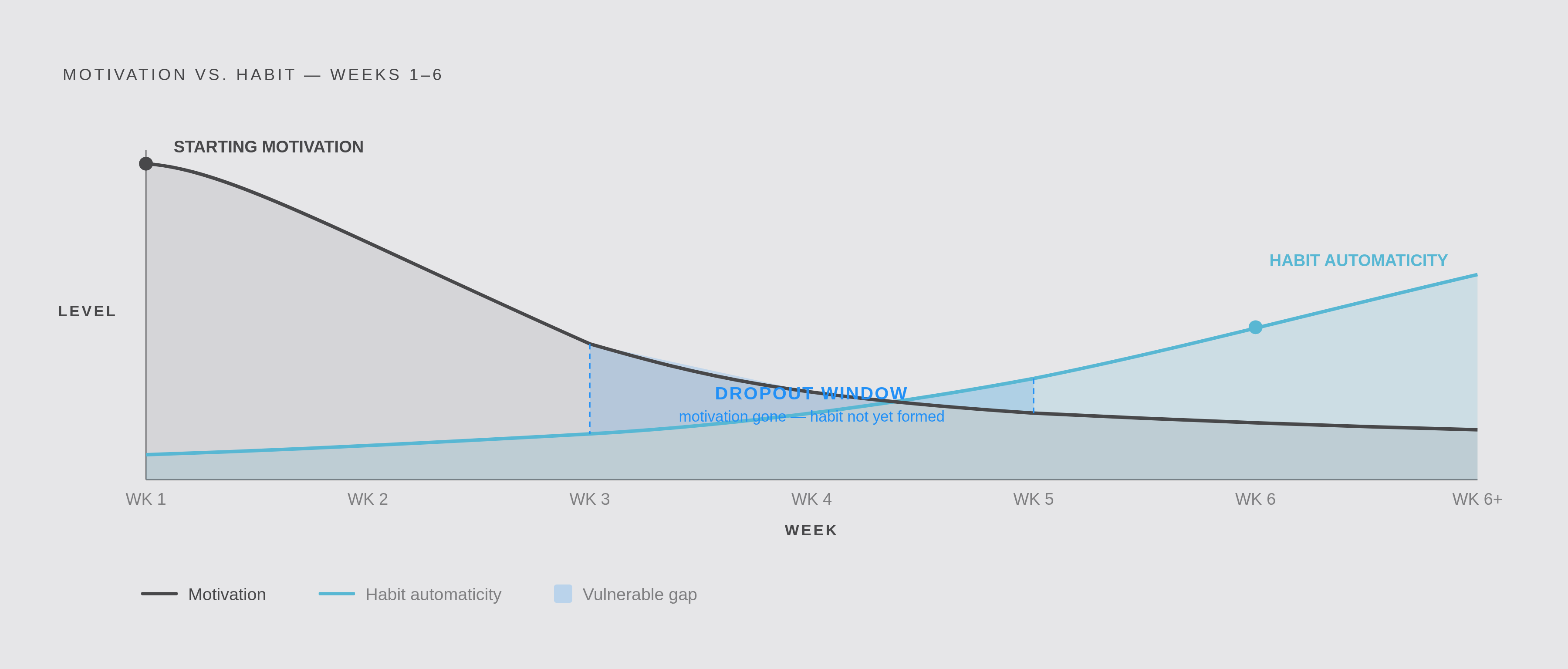
Around weeks three to six, that mismatch can start to feel especially hard. The emotional charge of a fresh start may fade within two to three weeks without visible payoff, while automatic behavior needs more repetition than a few weeks of inconsistent workouts provide. The calendar has moved faster than the habit. Each workout still takes a conscious decision, but the excitement that made it easy to decide has faded.
Week three is not a biological deadline, though. A 2026 Frontiers in Sports and Active Living study of a large mobile app cohort found a median dropout time of 19 weeks. That finding does not establish a universal third-week collapse, and the study should not be treated as proof of one. Beginners are at risk of quitting in the stretch between starting and getting into a steady routine, and that stretch has no fixed end date.
During that interval, the beginner is doing something awkward. During that stretch, beginners must keep putting in effort while they still lack both automaticity and a reward they can see. Sporadic attendance stretches that interval because there are fewer repeated loops for the brain to learn. What feels like a sudden personal failure can therefore be a mismatch between how long the starting excitement lasts and how long the routine needs to settle.
The specific mistakes that make the gap wider and dropout faster
Going too hard at the start makes this stretch harder to get through. Long, demanding sessions can produce soreness, fatigue and injury when recovery cannot keep up. Pain is a persuasive reason to cancel. Even without injury, a workout that demands too much time or effort creates friction, which encourages inconsistency and then weakens confidence.
Unrealistic expectations add disappointment to that physical cost. Visible muscle change takes several weeks, and visible fat loss takes longer, so expecting transformation in the first couple of weeks means judging the plan before it has had a fair chance. The verdict shifts from “this needs time” to “this doesn’t work.
All-or-nothing thinking then turns an ordinary missed session into an identity crisis. Someone committed to being “someone who works out every day” now has an action that contradicts that self-image, creating cognitive dissonance. Abandoning the plan can feel easier than revising the expectation. Yet a single missed workout does not derail long-term automaticity in the way a run of consecutive misses can.
Overcomplication creates another obstacle by making every workout a fresh decision. When the time, activity and plan keep changing, the stable cue-behavior association that a habit needs gets weaker. That is different from adding variety inside a dependable routine. Training alone can leave the beginner without an external cue or witness just as their private enthusiasm begins to fade.
Why each quit makes the next attempt harder
Quitting can change what the next attempt feels like before it even starts. Past behavior strongly predicts future behavior, and repeated dropout gives the beginner a record of plans that did not last. That record becomes evidence against another fresh start. The next missed workout can feel like more of the same.
Self-efficacy is the belief that someone can succeed at a particular task, and repeated failed attempts can erode it. A serial quitter may not merely want exercise less. They may be less convinced that effort will lead anywhere, which makes restarting harder to justify. Quitting before visible adaptation also deprives them of the positive evidence that might challenge that belief.
Over time, “that plan didn’t work” can harden into “I’m just not cut out for this.” This is the danger of learned helplessness, where repeated disappointment teaches someone to expect that trying will not change the outcome. The consequence is withdrawal before another routine has a chance.
The same app study found higher dropout risk among younger users regardless of sex, with risk declining across early and middle adulthood. That underlines the value of support for people likely to be starting fresh. The pattern is not destiny. Helplessness is learned. The cycle can be interrupted.
What actually closes the gap: external structure before internal motivation returns
A fixed cue, a manageable minimum and another person expecting a check-in can keep behavior moving without requiring fresh enthusiasm. This scaffolding makes repetition possible before repetition becomes easier.
The most useful minimum is a floor. During the vulnerable stretch, a workout that is manageable on the hardest day preserves the cue-behavior loop better than an ambitious session that never happens. Clearing that floor counts as success. Starting low and building gradually also avoids making full daily sessions the admission price for being “consistent.”
Partners, trainers and group classes give people someone to connect with when they work out, while sharing progress lets someone else see that they showed up. Dominican University research found that people who shared their progress each week were much more likely to succeed than those who worked alone. Keeping the promise now depends on more than how convincing the sofa seems that evening.
A routine can have structure even when the workouts change. The app study found that greater diversity in early exercise exposure was associated with lower dropout risk, including broader equipment use and more emphasis on strength-based exercise. That association describes a tendency. It backs keeping the cue steady while changing enough of the workout to keep boredom at bay.
How photo check-ins work as a habit-formation mechanic, not just a social feature
A workout photo can give a beginner something fitness itself cannot reliably supply at first, an immediate reward. Strength, endurance and appearance changes take time, while taking and sending a photo creates a small completion event straight after the behavior. A partner’s acknowledgment can follow within minutes.
That timing fits the habit loop described earlier. Instead of waiting weeks for evidence that exercise was worthwhile, the beginner gets a prompt social response to showing up. The photo also makes absence more visible. Skipping becomes something another person may notice, rather than a private decision that disappears without a trace.
Crucially, the check-in can document attendance without grading performance. A ten-minute walk earns it just as a full session does, which keeps the reward aligned with the minimum goal. The workout need not be impressive to count. Otherwise, taking the photo becomes one more hard thing to do in a routine that already asks a lot.
Sweatmates: Partner Fitness builds its SweatCam feature around this mechanism. Partners send workout photos as their primary check-in, making the behavior visible and shared rather than turning each session into a performance report. The product fits the structure because the photo records showing up. Its usefulness rests on that small, repeatable exchange.
The legitimate concern: when social accountability adds pressure instead of removing it
Being seen is not automatically a reward. For a beginner who worries about appearance, a photo requirement may add another reason to avoid the workout. Exercise already asks them to do something unfamiliar. Requiring visual self-presentation afterward can make the whole experience feel like an evaluation.
A July 2026 Frontiers in Psychology study found that seeing fitness posts on social media could lead people to compare how they look with others and to engage in greater body surveillance. However, the proposed negative pathway to reduced adherence was only partially supported, and the link from body surveillance to social physique anxiety was not significant. The finding deserves care in both directions. It gives a legitimate reason to question whether visibility feels supportive to a particular beginner.
The audience changes the experience of that visibility. A photo sent to a trusted partner is not the same arrangement as a post on a public feed or a competitive leaderboard. The relationship is different, and so is the purpose of sharing. A friend who is rooting for attendance need not judge the image as a display of fitness or appearance.
SweatCam uses a closed, partner-to-partner arrangement. That takes away the public setting for comparison, though some people may still feel uneasy about taking photos. Adding a witness helps only if that witness makes showing up easier.
What beginners can do in the first three weeks to survive them
For beginners, the practical move is to build these supports before enthusiasm fades. Start by defining the minimum workout that counts on the worst day of the week, and treat completing it as full success. Performance targets can come later. This keeps a difficult day from forcing a choice between an ambitious session and nothing.
Fix the training time rather than relying on an intention to exercise sometime. A standing cue removes a daily decision and gives repetition a dependable starting point. Keep that cue the same while making small changes to the workout. A different exercise or a walk instead of a gym workout can reduce boredom without requiring an entirely new plan.
Find someone who can see that the workouts happen while getting started still feels easy. That might mean telling someone the plan, recruiting a partner or using a tool that makes attendance visible. If photos feel comfortable, send a check-in straight after the workout so the acknowledgment stays close to the action. The partner’s job is support.
When a session is missed, treat it as data. The useful rule is never miss twice, because consecutive absences are where dropout risk begins to compound. Go back to the minimum without asking for a heroic comeback. Then share the check-in, even when the workout was modest and nobody measured a thing.
Sources
- Highlights From Occasional to Steady: Habit Formation Insights From a Com-
- HabitWalk: A micro‐randomized trial to understand and promote habit formation in physical activity - Baretta - 2025 - Applied Psychology: Health and Well-Being - Wiley Online Library
- Supporting Habit Formation in Pre-Meal Photo Capture: A Longitudinal Study of Behavior Change Techniques
- Sweatmates — Fitness Accountability With a Partner
- Motivational Determinants of Exercise Behavior in Fitness Centers: Insights from PALMS and Public Health Perspectives