What Actually Happens When Two People Try to Track Workouts in One Place
Shared tracking fixes visibility fast, but not mismatched bodies and goals.
The best couples workout app depends on what the couple needs to share, whether that is attendance, training data, or a guided session. For engaged couples getting in shape before their wedding, start with a system that lets each person see the other’s workouts without asking both to perform at the same level. Tracking workouts together works best when both partners agree to show up, while each trains in a way that fits their own body, goals, and schedule.
Why fitness apps built for one person create two separate problems when shared
The intention is to get fit together. The standard solo app delivers something narrower, a place to record one person’s training, with social features attached. Most fitness apps were built for one person to use, with partner features added later. Putting two people into that setup can give them adjacent paperwork.
That design gap produces two different problems. A partner’s activity may become visible too late to influence the other person’s choices. Different bodies, abilities, goals, and schedules are incompatible with a single standard. An app can fix the first without touching the second. Seeing a partner’s workout instantly does not make their pace, load, or available training time suitable for someone else.
The visibility problem and why a weekly summary cannot change Tuesday
A Sunday recap can describe a missed Tuesday session, but it cannot put accountability back into Tuesday. By then, the decision has already passed. Shared tracking needs to make activity visible while both partners can still respond to it, rather than saving everything for an end-of-week reckoning.
A private missed workout stays between a person and their own intentions, which can be a remarkably forgiving committee. Once someone else can see whether the session happened, they also know when it was skipped. For that shift to occur, the partner needs to know whether the commitment was met.
Light stakes give that commitment a defined consequence. Dinner or a chore is more concrete than a vague promise to try harder, but the consequence needs to follow something both people could see unfolding. If the missed goal only emerges from a later reconstruction of the log, the wager can feel arbitrary. Timely visibility connects effort, social cost, and the agreed consequence. A weekly summary is useful as a wrap-up.
How photo check-ins solve the visibility problem in practice
A workout photo shows that the person showed up, and their partner can see it now. Unlike a delayed summary, a timestamped check-in does not ask the partner to piece together what happened earlier in the week. It turns an assumption into visible evidence without requiring either person to interpret a training log.
Sweatmates does this through SweatCam, where partners agree on how many days to work out each week and log each session with a photo the other sees right away. A small, pre-agreed wager, such as dinner, coffee, a chore, or a custom stake, applies if the weekly goal is missed. Hitting the goal means nothing is owed. The consequence attaches to attendance.
The supporting features include nudges, home screen widgets, a Pinky Promise appeal for a missed log, and weekly and monthly recaps. The recap comes after the accountability. In Sweatmates, the immediate check-in, the partner’s awareness, and the small wager work together throughout the week. Neither person has to wait for Sunday to learn that the other has been active.
Reliability is the catch in that design. Google Play user reviews flag crashes, slow SweatCam uploads, and errors that prevent photos from posting, particularly on Android/Galaxy devices, as well as a subscription requirement that surfaces after setup. A failed upload undermines the very signal the system depends on. The mechanic is straightforward, but a workout that happened should not look like a missed commitment because the camera feature had other plans.
The compatibility problem and what breaks when bodies and goals do not match
Even a perfectly delivered photo cannot make two people need the same workout. When partners at different fitness levels are held to the same standard, the stronger person may hold back or get bored while the newer person feels overwhelmed. Neither gets the session they need. A common log can make that mismatch visible without offering any way around it.
The relationship dynamic can become awkward too. When the more advanced partner defaults to coaching, training together starts to resemble a clinic, with one person directing and the other receiving corrections. That shift routinely generates conflict. A partner may have signed up for company. Better notifications cannot resolve that role mismatch.
Schedules add another layer of incompatibility. Different availability windows mean that a shared fitness effort often involves separate sessions, which attendance tracking accommodates more easily than a system built around comparing performance. This is why tracking together and training together need to be treated as different ambitions. They can overlap, but they do not have to. Nor can an app feature, on its own, stop a less engaged partner from drifting away, regardless of how well the software handles the logs.
How can an engaged couple work out together at different fitness levels?
Relative-progress scoring tracks how each person does against their own goal. Both can track sessions completed, minutes moved, and streak days without making every comparison a contest over pace or load. Each person has a commitment that is their own to meet.
Each partner trains in the format that suits them, then contributes to the same attendance record or shared streak. Because Sweatmates is an accountability layer rather than a training program, each partner can set an individual weekly goal as well as shared team goals. One can run while the other lifts. The shared task is keeping the commitment, although that structure cannot create engagement where a partner has none.
Couples who want some sessions together can also vary the intensity within them. Doing the same movement at different loads lets each person train at the level they need, while intervals where the fitter partner loops back let both go at their own speed on the same outing. Neither person has to spend the session waiting. These formats preserve the company without requiring equal capacity, which is a more useful compromise than asking either partner to abandon their own training needs.
App design can support the same separation. A system that gives each person a plan suited to their level while allowing shared sessions respects the gap better than one that forces a single program on both. For an engaged couple, the wedding can be the shared reason to begin without becoming a demand for matching workouts.
What couples who want detailed training data actually need versus what shared accountability provides
A photo proves presence. It cannot distinguish a hard workout from a half-hearted one, and couples following structured programs are right to see that as a limitation. Attendance and training data answer different questions. The first establishes whether a person showed up, while the second reveals what they did once they arrived.
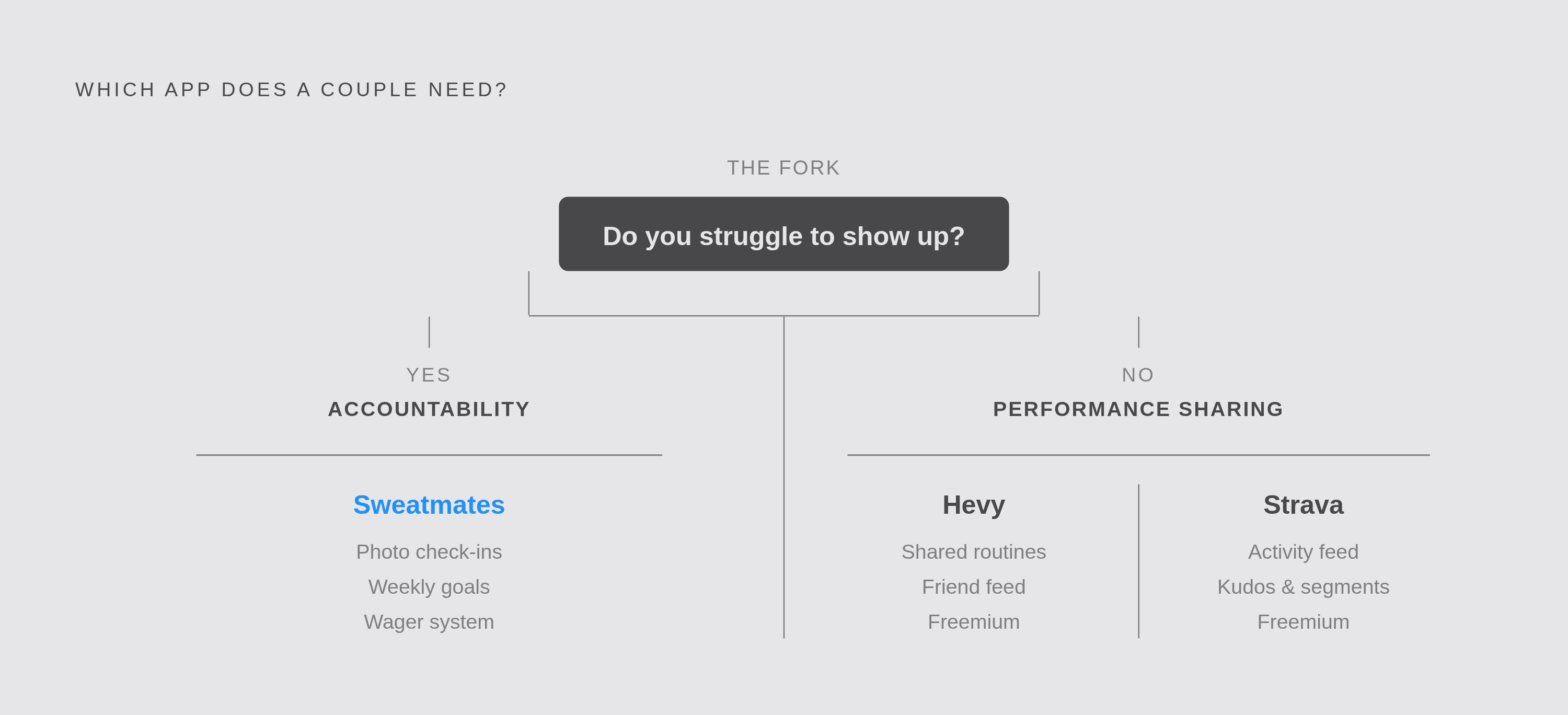
Hevy offers shared and copyable routines, a friend feed of logged workouts, and a usable free tier within its freemium model. Its shared view is the session log itself. That suits gym partners who want to see each other’s actual training. Strava takes a similar social approach to running and cycling through an activity feed, kudos, and segments for friendly competition. It is also freemium, with performance providing the basis for the interaction.
Those tools fit partners whose training is already happening consistently. They help partners connect over the workouts they do, with less focus on getting them to show up. Couples can choose based on whether they struggle to show up or already show up but feel out of touch with each other’s training. In the first case, detailed logs are secondary to the habit. In the second, those logs are the point, and a photo-only system may leave both people wanting more.
The categories do not have to compete. Each person can use an app that fits their sport and keeps the workout details they need, with a shared accountability layer on top. A runner and a lifter need not force their sessions into one performance language just to support each other.
Apps for guided partner workouts when couples want the same session
Some couples already have the time and willingness to exercise together but do not know what to do. Their missing piece is a guided session. FitWithLove: Couple Workout, from Life Activator, is available on Google Play and the App Store and offers partner exercises for use at home without equipment. Its routines cover couples yoga, strength, and flexibility, as well as routines marketed for belly fat reduction and weight loss.
The app has structured plans for each day and lets each person track their calories. Its other features include streak tracking, achievement badges across six categories, a personal records dashboard, completion certificates, cloud backup, and smart reminders. It is free with ads and in-app purchases. A Pro plan is available as a one-time purchase that removes ads and unlocks exclusive plans. It is available in eight languages, namely Arabic, German, Spanish, French, Hindi, Indonesian, Italian, and Portuguese.
That is a different service from sharing proof or performance. Guided partner workouts answer the question of what to do together, generally assuming both people can train in the same space. They do not remove conflicting schedules or provide the same function as real-time attendance tracking.
Why focusing on showing up resolves both friction points at once
A beginner and a seasoned athlete can both meet a commitment to train, even when their sessions look nothing alike. A photo check-in makes that commitment visible as it happens, so the social effect lands during the week.
A small, agreed consequence follows a missed attendance goal. Neither partner is penalized for having a different body or starting point. That removes the demand that they prove commitment through comparable numbers. The relationship does not need a league table.
For couples preparing for a wedding, the practical lesson is to separate the shared promise from the individual workout. Both can work toward looking and feeling their best without following the same plan or being free at the same hour. A simple, visible signal and light stakes make skipping a conscious decision. Consistency is what produces fitness outcomes over time, so the best shared system is the one both people keep using.